¶ System Architecture
The Defend-O-Tron runs Debian Linux. The components that sit on the traffic path run directly in the operating system, for speed and direct access to the network. The supporting services run as isolated Podman containers, which the device’s do-stacks tool starts, updates and reports on. See do-stacks.
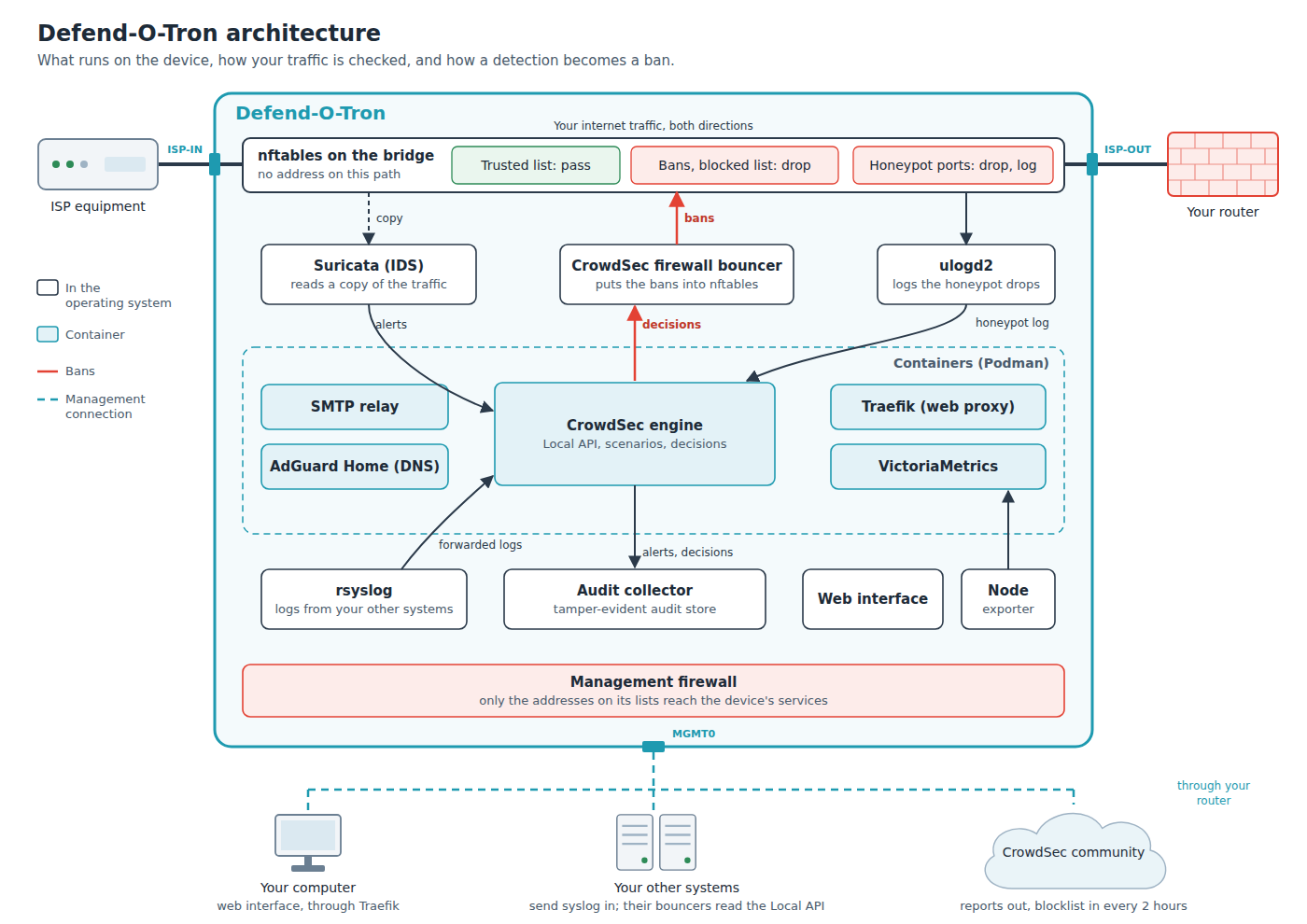
¶ In the operating system
| Component | What it does |
|---|---|
| nftables | The firewall. It runs the bridge between ISP-IN and ISP-OUT, the blocked and trusted lists, the honeypot, and the firewall of the management port |
| CrowdSec firewall bouncer | Puts CrowdSec’s bans into nftables, so banned addresses are dropped in both directions |
| Suricata | The intrusion detection system. It reads a copy of the traffic on the bridge and writes an alert when a rule matches |
| ulogd2 | Logs the packets the honeypot drops, for CrowdSec to read |
| rsyslog | Receives syslog from your other systems. See Log Ingress |
| Audit collector | Records events, decisions and admin actions in the tamper-evident audit store. See Audit Evidence |
| Web interface | The device’s own web pages |
| Node exporter, chrony | The device’s measurements for the metrics store, and its clock |
¶ In containers
| Container | What it does |
|---|---|
| CrowdSec | The detection engine and its Local API. It reads the Suricata alerts, the honeypot log and the forwarded logs, decides what to ban, and exchanges reports and the community blocklist with CrowdSec |
| AdGuard Home | The DNS filter. See DNS Filtering |
| Traefik | The web proxy in front of the web interface, AdGuard Home, the metrics store, the CrowdSec API and its own dashboard, with the device’s certificates |
| VictoriaMetrics | The metrics store behind the charts |
| SMTP relay | Lets the device’s services send email, such as CrowdSec’s email notifications (off by default) |
A support container also runs, but only during a remote support session.
¶ How a Packet Passes Through
- A packet arrives from your ISP on ISP-IN. The device has no address on this path: it works as a transparent bridge.
- nftables checks it. A packet from a trusted address passes. A packet from a banned or blocked address is dropped. A probe to a honeypot port is dropped and logged.
- Everything else passes to ISP-OUT and your router. The same checks apply to traffic going out.
- Suricata reads a copy of the traffic, so it never slows it down, and writes an alert when a rule matches.
- CrowdSec reads the Suricata alerts and the honeypot log. When a scenario matches, it makes a decision (a ban), and the bouncer adds it to nftables within seconds.
- CrowdSec reports the attackers it bans to the CrowdSec community, and downloads the community blocklist every 2 hours.
- The audit collector records the alerts and decisions in the audit store, and the metrics store keeps the figures for the charts.
The management port, MGMT0, is separate. It has its own firewall, and only the addresses on its lists can reach the web interface and the other management services. See Firewall.
¶ Related Pages
- Protection Test: this architecture against a real port scan.
- Honeypot: the rules that catch port scanners and brute-force attempts.
- Honeypot Internals: the nftables hooks and the packet path in detail.
- Log Ingress: sending logs from your other systems.
- Compliance Reporting: how the audit store keeps tamper-evident evidence.